
Case Study
Resources >> Case Study >> Streamlining Manufacturing Process Planning
CS/26/AERO/014
Streamlining Manufacturing Process Planning
Business Challenge
Manufacturing teams relied on fragmented and manual workflows while creating and managing Manufacturing Process Plans (MPP). Several limitations within the existing PLM setup caused inefficiencies and increased operational risk:
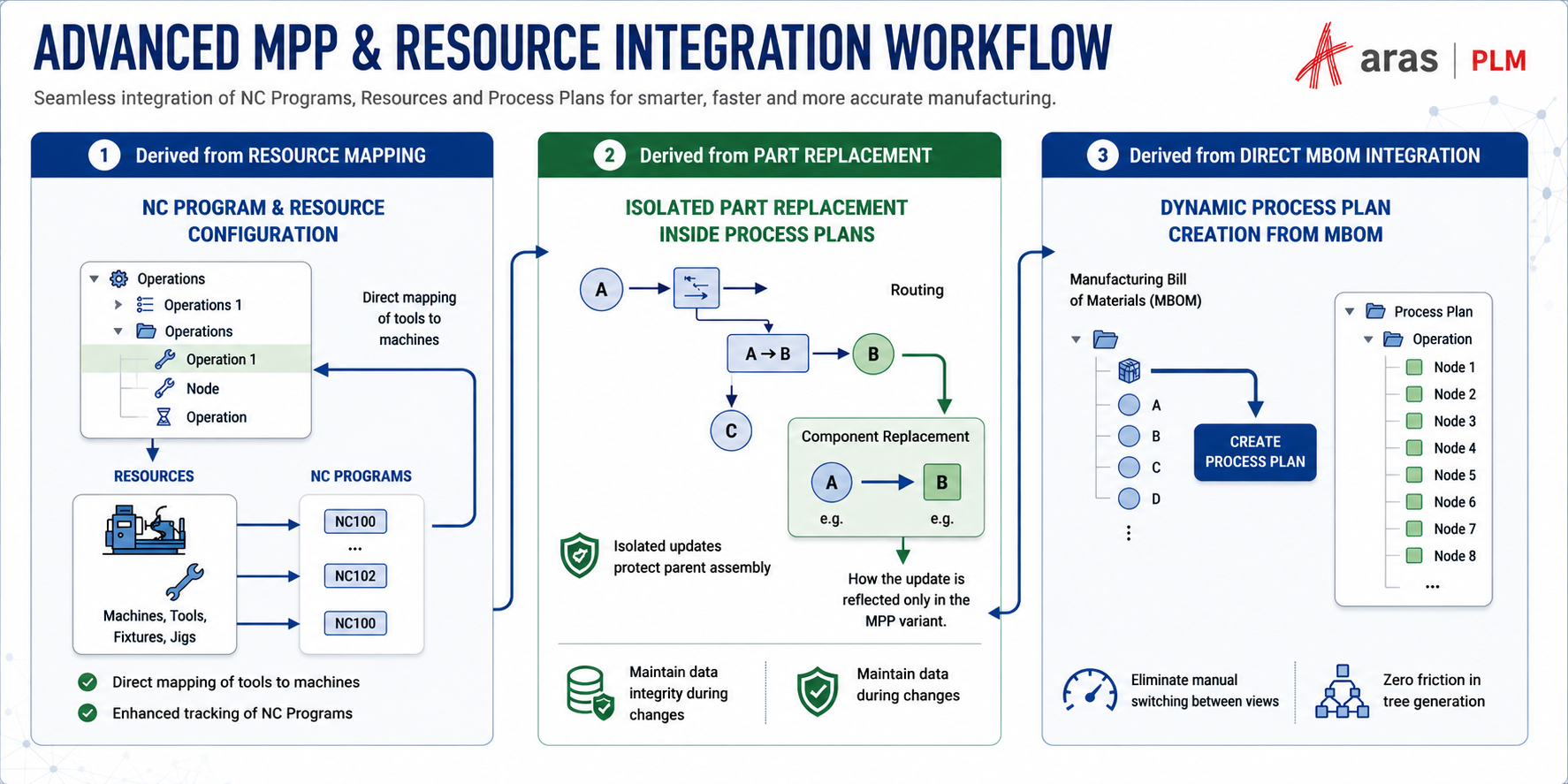
- NC Programs could not be directly associated within Process Plans, forcing external tracking.
- Part quantities had to be manually entered during drag‑and‑drop operations from the Workbench.
- Consumed parts in Process Plans could not be replaced without manual rework.
- Users were unable to create Process Plans directly from the MBOM view, requiring unnecessary context switching.
- Export functionality did not fully support Process Plan data for IBS parts.
- There was no standardized mechanism to import Process Plan data from external systems.
These gaps resulted in higher manual effort, data inconsistencies, and reduced productivity across manufacturing planning teams.
Solution
Targeted enhancements were implemented within Aras PLM to streamline Manufacturing Process Planning and improve overall usability:
- NC Program integration was enabled directly within Process Plans, creating tighter alignment between planning and execution data.
- Automatic part quantity initialization from EBOM was introduced during drag‑and‑drop, eliminating manual entry.
- A controlled “Replace Part” action was added for consumed parts in MPP, preventing unintended changes to original assemblies.
- A new “Create Process Plan” action was introduced in the MBOM view, allowing users to stay within their working context.
- Export functionality was enhanced to fully support Process Plan data for IBS parts.
- A standardized IBS Import action was developed to allow importing Process Plans from external systems using pipe‑separated files.
Business Impact
The enhancements delivered tangible improvements across manufacturing planning operations:
- Improved efficiency through seamless creation and management of Process Plans within PLM.
- Reduced manual effort and errors by automating part quantity assignment.
- Simplified part replacement while maintaining integrity of original product structures.
- Enhanced user experience by eliminating unnecessary navigation between views.
- Improved data exchange and interoperability with external systems through standardized import and export mechanisms.
- Stronger governance and consistency across manufacturing processes.
Conclusion
By enhancing Manufacturing Process Planning capabilities in Aras PLM, the organization successfully removed critical workflow bottlenecks and manual dependencies. The solution streamlined planning activities, improved data consistency, and strengthened integration between design and manufacturing. These improvements positioned PLM as a more effective system of record for manufacturing operations, delivering measurable efficiency gains and a better user experience.